This is where I will put copies of my blogs for better organization. Comments dont work here so go to posts on the front page to comment.
Wysocki, Bernhardt, and Wysocki. Thoughts on Modern Media and Digital Design.
The first thing that stuck out to me in Bernhardt’s piece was that he placed essays at the visually non-informative end of the spectrum. This concept was counter-intuitive to me. After all, words are visual, and therefore must in some way be visually informative, but the concept sank in the more I thought about it. Barring the actual text of a piece, very few things other than the words in an essay that convey information. He makes the point that there are indentations and punctuation in essays, but these visual cues are strictly defined for their individual use. In an essay, they exist primarily to make the structure visually pleasing and easy to read. There is no true meaning conveyed by the indentation of a new paragraph beside providing the reader with a clear indication that a new paragraph has been formed. This, I think, aligns with what Wysocki is saying in her introduction to her book. She gives commentary on how writing is changing, as really has always been changing. Writing and communication as a whole are much more than the words that make up any particular text. This I believe can be seen much better now than when Wysocki originally wrote her book. If we take a look at the form that modern media has taken over the past few years, it is truly amazing how sleek and immersive some articles and media can be, such as:
https://www.abc.net.au/news/2017-10-16/north-korea-missile-range-map/8880894
Or
https://www.abc.net.au/news/2017-09-13/same-sex-marriage-support-map-vote-compass/8788978
This highlights an important concept to take note of, especially in this digital age where our attention is constantly be fought for by countless different sites and modes of consuming media. The way information is delivered is just as important as the information being delivered. This is probably common sense for anybody familiar with marketing or advertising because it is the basic concept that those industries are built on. Making something that can grab and maintain people’s attention is what every person should be trying to do in the digital age.
“There is little or nothing that asks composers and readers to see then question the values implicit in visual design choices, for such design is often presented as having no value other than functionally helping readers get directly to the point” If there was one quote that has become dated in Wysocki’s “New Media,” I feel this may be the best example. Personally, I find design to be one of the defining characteristics of new media. If an app, website or article isn’t well put together and run smoothly, I feel no obligation to use it and will try to find a better alternative. This can be for better or worse. The challenging demands that I and many other media consumers have challenge people to become more creative, and create more visually pleasing and fun articles. A perfect example is The Guardian’s piece on the internet in communist countries:
This article has so many small details in the design that make it exciting to read in addition to the interesting topic. It is the perfect example of setting a new standard for modern news articles. The downside to this is that the average person with limited resources may be pushed aside for not having such a gripping design. This doesn’t make new design for media a total scrub; it just means that when consuming it, we as an audience have to be aware of what purpose it is achieving. If the design of a news article is the only substance that it provides, then I feel we are in a much worse place than if we had settled for the classic information packed and visually bland essay.
Fisher and Porter
Today’s blog will be something a bit different from last’s, it will be more of a stream of concious thought on interesting parts of the reading. Welcome to this journey, hopefully you have the same expectations about this as you do about any Lifetime movie in existence, fairly low with the possibility of being pleasantly suprised.

“Humans as rhetorical beings are as much valuing as they are reasoning animals.” I find this quote significant and intriguing, partly because the author did the work for me in making it clear it was a good one by italicizing it. What I get from the rest of this paragraph is that logic and reason may not always be expressed in logical or reasonably ways. In fact, I would argue that unreasonable acts and statements, made to prove a point, stick with people better than the average reasonably boring way of putting it. The absurdist setting of Alice in Wonderland may be what makes it’s themes of growing up and finding identity more memorable than that of Heart of Darkness.

(I’ll be honest, growing up definitely isn’t a theme in a book about some grown-ass dude floating down the Congo in the middle of Africa, but overall I have lackluster feelings about this book and Joseph Conrad as a person so we can all just pretend that this was a good analogy)

The piece goes on further to argue that all rhetorical situations are completely unique and circumstantial, as nearly all things outside of math and some science are. The exigence for every writing is different from author to author and each piece’s relevance and significance isn’t constrained to the author’s intent, but also to when in was written, who and why it was written for, and ultimately how each individual reader interprets the reading. Once something is published, the piece becomes just as much the reader’s as the author’s, maybe even more so. The author isn’t there for each reader to ask questions on the intent or purpose of what was written, the words are just sitting there for each individuals interpretation. Much how I am almost certainly extrapolating different ideas than the author intended from his/her writings.
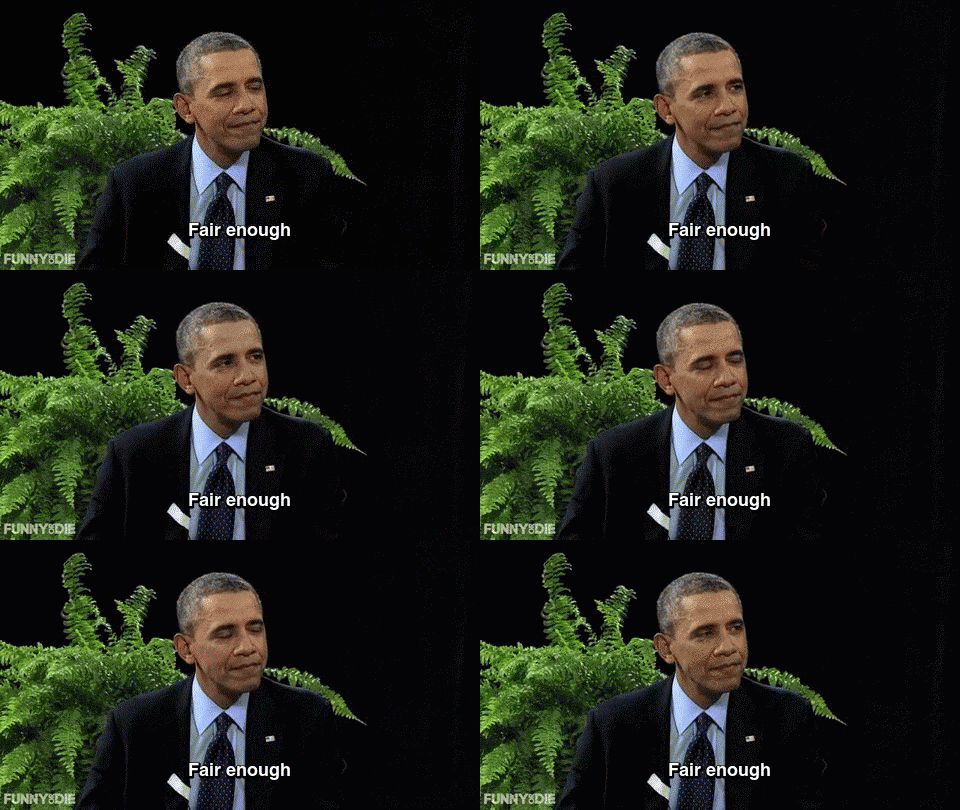
I suppose that this is what Porter’s piece on intertextuality is talking about. No writing is an island. Each writing, whether intentionally or not, relates to others. On the large scale they may represent a genre, a period in time, a school of thought, or a specific style of writing. They could connect with other texts more directly by referencing them, quoting them, or use similar themes and settings. These are what Porter describes as the two forms of intertextuality: Iterability and Presupposition. From what I understand, Iterability is the equivalent of using a star wars gif to make a point:

And Presupposition is me hoping you will appreciate this gif that is funny, but isn’t quite Star Wars, but you’ll find it funny because you have seen Star Wars and the concept is familiar but the content is new to you, or that as my audience you will at least have a similar sense of humor

Overall, if I can be so cocky as to assume that I have grasped the overarching theme of this week, it seems that both of these texts were in one way or another saying that, everything references some other thing, even if it is unintentional, and the audience of a piece is just as important as the author and sometimes can find their own meaning for a piece based off of events that may not even be covered in the piece, even if it was unintended by the author.
And, with that eloquently written run-on sentence that would make my previous English professors sob in disgust, as they contemplate how they so horribly failed me as a writer, I am done.

Applying Principles of Rhetoric to Modern Digital Media
Near the start of the “Downs” piece about rhetoric, the author highlights a subset of people that are skilled in their use of rhetoric, including lawyers, comedian and counselors. The author also says, “Rhetoric is an operating system for human interaction and meaning-making.” With modern technology, rhetoric is more widespread now than ever before. In today’s age, video, articles and pictures can be shared more easily and effectively than any other point in history. This gives many people the chance to use technology to share the ideas of others and create their own content on a worldwide scale. This brings up the question, “Is this necessarily a good thing?”
Working through the “Rhetorical Elements” provided in the reading, we can highlight some of the pros and cons of this modern age of mass-media and social sharing. The motives for digital content creators including bloggers, vloggers, youtubers, and even those people who leave comments online is generally two-fold. It is to both share their ideas, experiences and thoughts and in many cases it is also to create revenue. This dual motivation is where problems start to arise with modern media. The amount of money generated isn’t based solely on the quality of content, as was typically the case for future generations. Well-written and thoughtful books and news articles were generally the ones that became most successful and therefore profitable. Now, it seems that shock value and absurdity are just as important, because if you can get someone to click to your website or video, you have already gained the ad revenue and keeping the people there is less important. To learn more about this “clickbait” culture, you can watch this video, which covers the topic pretty well: https://www.youtube.com/watch?v=sIYnH1jCOXI&ab_channel=WheezyWaiter
Generally, I would argue that the ease of creating and sharing content for profit in the modern age has led to massive amounts of poor quality content being shared, in many cases simply for profit.
Good ways to avoid this ever-prevalent “fake news” is to find places online with a good community of people that enjoy the content and for each story, video or post to provide a good “ecology” for the pieces intended purpose. This means that whether the content is meant to be entertaining, educational, or just plain dumb and funny, it should provide a non-hostile environment that doesn’t contain people disseminating falsities.
With educational or informative online content, many of areas of rhetoric are the same. “Knowledge Making” is still one of the main goals and still very similar to previous media. Whether it is videos or text, informative digital media still maintains a specific narrative for each piece, and makes rhetorical appeals in similar ways. Additionally, modern media still clearly has the five rhetorical canons of discourse, but the arrangement, style and delivery are typically vastly different from that of previous media.
Modern media has a broader scope and diversity than any other point in history and is only growing. While many of the basic principles of rhetoric can be seen in today’s media, it is also more prone to abuse, misleading, or even blatantly false content. These problems can be avoided by being smart about where a person consumes their content, but it is not entirely avoidable. I would be interested to know if others believe that modern digital media is possibly more destructive than in the past, or if there really is a difference in the type of content produced in the digital age? Is there just much more videos and articles being created but in the same proportion as in the past?
 Streeter's Generic Blog
That’s exactly the right way to go into viewing a Lifetime movie! xD
I love that you brought in Alice in Wonderland. I’m a big fan of the book, mainly because of how confusing it can be. I think sometimes that the things we don’t understand are the things that can impact us the greatest. There are so many little themes and hidden metaphors in Alice.
“Once something is published, the piece becomes just as much the reader’s as the author’s, maybe even more so.” What do you think about this? I understand where Porter was coming from with this, but I’m not sure I can agree entirely. The author had a specific thing in mind when writing, which readers might not even get? There’s definitely a connection between a reader and the writing, but I feel like the original author might hold more power in that triangle.
I think it’s hard to say whether media is more destructive these days… It might be that the atmosphere is more hostile, or it might be that is just seems that way because we have access to more types on content than ever before. One thing’s for sure: there’s no shortage of rhetoric going on in today’s society.
LikeLike
Your blog on the Fishr and Porter and the intertextuality of text is really good. Not only did you summarise Porter’s idea of the two types of itnertextuality through the use of gifs, but you also sumarrise the idea that porter took seven pages to explain within a short blog.
I felt like you kinda went off path in the beginning of the blog, since, your analogy with alice in wonderland didn’t make sense to me, or at least I didn’t see the connection to Fisher’s idea of narrative and real world paradigm, so i didn’t understand the purpose of that.
LikeLike
Notes on Wysocki/Bernhardt: lolz
“There is little or nothing that asks composers and readers to see then question the values implicit in visual design choices, for such design is often presented as having no value other than functionally helping readers get directly to the point”
Going forward, if all media’s ulterior motive is compression, do you think this could have a detrimental effect on the communication process as a whole? You have acutely pointed out in your blog that within this age of saturated media, its becoming unprecedentedly difficult to break through the noise. The most precious commodity is attention. With so many competing channels of media, it has become an arms race. So my question to you is, as more and more channels of media participate in this war of attention, could we be losing something along the way? Are some topics just too complex to be conveniently compressed? Or will the media channels that are adroit at taking byzantine issues and regurgitating them into digestible bite sized pieces prevail?
LikeLike
(I guess people have been commenting here, so I’ll stick with the status quo?)
It’s funny you had that initial reaction to Bernhardt’s assertion about essays being the least visually-informative. I had the exact opposite reaction, which is to say I heartily agreed with the author instantly. As a graphic design student, I think there are so many ways to express information in both color, layout, and typography that simple, stark scholarly essays just can’t measure up to.
In marketing these days, there’s definitely a lot of competition. Companies are competing with one another for your limited attention span, and they’re going to more and more outragreous ways to keep it. (Like this offer from VitaminWater: http://mooseradio.com/this-company-will-give-you-100k-to-ditch-cell-phone-for-year/ challenging customers to give up their phones for an entire year!) In this crowded age of digital media and marketing, only the most clever and well-designed ads can stand out.
LikeLike