The Six Steps

(the ones about art not drinking)

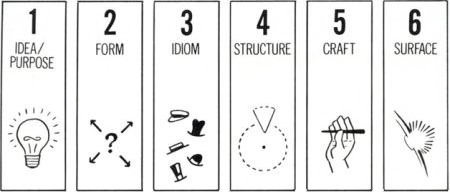
In chapter 8 of McCloud’s book, he covers what he calls “The Six Steps.” These steps are idea, form, idiom, structure, craft, and surface. He goes into great depth of what each of these steps represents and how they are used to varying degrees in comics. He also states that all art holds these six steps and that for many, we are drawn in by the least impactful and easiest to achieve of the steps, surface, and if we are true fans of the art form then we stay, consume and create for the other steps. Essentially, most of us are drawn in by flashy covers or titles and come to truly love art for its deeper substance.

Image result for scott mccloud's six steps

Since McCloud does a great job of detailing what these steps look like with comics, I figured I could run through a few examples of books that lack some of these important steps.

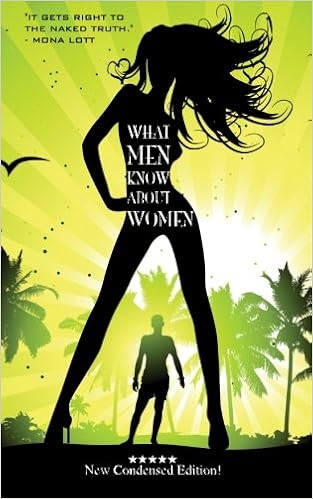
The first culprit will be the book, “What Men Know About Women.” This book is lacking the fourth and fifth step of structure and craft when it comes to books. Someone had this great idea(1), put it in book form(2), with a catchy title and cover(6) and most importantly the subject matter on the pages(3) which is in fact nothing! Yes, it is a joke book and the fact that there is no content is the content.

Another great gem that is extremely in the surface department but overwhelmingly lacking in the (every single other) department is, “A Billionaire Dinosaur Forced Me Gay.”

A Billionaire Dinosaur Forced Me Gay by [Fox, Hunter]

This absolute masterpiece of a book is a whopping 15 pages of weird “50 Shades of Gray” spin-off that is pretty much sold off its title, the definition of all surface no substance.

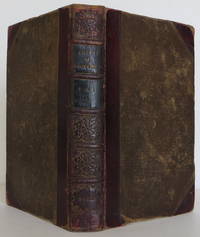
Many instances of books that hold all of the steps except for surface are many first prints of true literary classics. Masterpieces of their time and still holding their place in many peoples (including mine) favorite books, such as Frankenstein, Dracula, and the Count of Monte Cristo.

These are all books built on great ideas, well written, with interesting structure, fantastic plots, and thought-provoking scenes. All tied nicely together by the hands of skillful authors that were true masters of their craft. But compared to today’s standard for book covers they all look like shit!

FRANKENSTEIN: Mary W. Shelley

Image result for the count of monte cristo first edition

Dracula has a boring and terrible quality picture on the front, Frankenstein only has the title, and The Count is literally just a blank box! Yes, the modern covers are much more tasteful and put together and yes, they are old and didn’t have current printing and design technology and yes, they probably looked great for their time.

The point I’m trying to make is that not everything has to hit all the marks for us to enjoy them, and for many people, some books will hit all the steps when others don’t. At the end of the day, I just hope that more people come to appreciate this art that we call literature and if that happens to start with gay dinosaur CEO’s and leads to somewhere better, than I suppose I can live with that.

CPE Proposal


Literacy is a word that for many has come to stand for competency or knowledge with one of possibly millions of topics, including math, computers or even smart phones. But literacy is also commonly used to specifically refer to a person’s ability to read and write. This use of the word literacy is what I would like to focus on. A question that I have always thought about is “How has literacy changed throughout human history?” Not exactly in that way because I am in fact not a complete literacy nerd, but I have spent a lot of time thinking about what the average person’s reading and writing abilities were in decades and centuries past. I have also spent an equal amount of time looking into the lives of old authors to gain some understanding of what types of live the “literate” held in different time periods of history.

I hope to present this topic as a vignette of each century, from the 1400s to now. I want to answer the questions of What were the literacy rates at that time? (of either the world or maybe the US after it becomes the US?) What was “literacy” for the common person? What was the life of a truly “literate” person like at that time? And finally I would like to highlight popular works and authors of the period to give a proper setting for the reader. I want to do this all in one report to properly encapsulate the major aspects of literacy, so people can have the proper perspective of where we used to be as a society, in order to understand how far we have come.

I am thinking of doing the prior in an order that is yet to be determined and may do “Biographies” of the common and literate people of the time to make the information more enjoyable and identifiable to readers.

A lot of my sources cover literacy rates of the past two or three centuries so finding numbers that go back to the 1400s may be challenging. Additionally, I haven’t looked at specific works or authors from any century but that should be the easy part of the research. Overall the following sources offer a good starting point to understand how literate we have become as a society, but don’t offer as much information on how illiterate we were (probably some correlation there.) Overall, online research sources will be my friend and numbers will ultimately be a large part of my final report.

Max Roser and Esteban Ortiz-Ospina (2019) – “Literacy”. Published online at OurWorldInData.org. Retrieved from: ‘https://ourworldindata.org/literacy’ [Online Resource]

This first source may be one of the most extensive sources that I have found. I gives hard numbers and graphs for a whole host data sets including World Literacy Rates since 1800, literacy in specific countries in Latin America, education rates and other correlating factors that relate to literacy. Finally, this source is a great spring board for finding other sources. It has a few links to historical literacy estimates that go back to the 1400 and 1500s based on signed documents and book sales at those times and has a lot of great references on where the author sourced his information.

Overall, there is a lot of content from this source that I can dig through. It gives me options for different perspectives I can take on literacy and how/why it has evolved and what correlating factors might be related to an increase in literacy, or vice versa.

Paul Gee, J. (1988). The Legacies of Literacy: From Plato to Freire through Harvey Graff. Harvard Educational Review, 58(2), 195-213.

This is probably the densest essay of the bunch but one that may provide the most extensive insight into the history of literacy. This is actually more of a review of the vast array of Graff’s work and summarizes a lot of his points under the pretense of making a complete history of what literacy is and where/when it first truly started for the modern world as it is used today. It also mentions the impact and importance of literacy at different points in history and the greater effect of this literate culture.

I believe this essay will be a foundational piece to my project as it covers many of the aspects of what I am looking to have in my project. It is a little lacking in hard numbers but that deficit can easily be made up with many of the other sources I have gathered. This piece is a great source of expert opinion on what literacy was and has become for our society.

Wagner, D. A. (2011). What happened to literacy? Historical and conceptual perspectives on literacy in UNESCO. International Journal of Educational Development,31(3), 319-323. doi:10.1016/j.ijedudev.2010.11.015

This article analyzes the impact of UNESCO’s nearly six decade dedication to be the international agency leader in literacy. The essay takes a look at how UNESCO has acted to help improve world literacy rates, and by how much these rates have improved. It goes on to mention that other aspects of educational development have received greater attention and resources by donors recently and analyzes how UNESCO’s literacy work will be affected by this increasing lack of resources.

This article will prove to be useful when analyzing more recent literacy data and how/why these rates have improved and what we can do in the future to further improve literacy rates. This source will be a good reference for more modern data and when speculating what world literacy will be like in the coming future.

Yurtoğlu, N. (2018). Excerpts are taken from Chapter 1 of 120 Years of American Education: A Statistical Portrait. History Studies International Journal of History,10(7), 241-264. Retrieved from https://nces.ed.gov/naal/lit_history.asp.

This source looks at a couple of the key factors that relate to literacy from 1900 to present. In addition to historical literacy rates in the United States, this essay also provides data on the education of the general population, including enrollment rates and educational attainment rates for the population. While not a long source, it is filled with good information and numbers to reference.

This is a great resource to highlight what the average person at any point in the last 100 years life would be like, and how likely they were to be literate. This provides information to be compared to the world rates, and makes giving a “biography” of the average and literate person of this era easier.

Graff, H. (1987). The labyrinths of literacy : Reflections on literacy past and present. London ; New York: Falmer Press.

This piece looks at the history of literacy in North America and Europe and goes through arguments to disprove some misconceptions that many people may have when it comes to literacy. These misconceptions include the idea that industrialization depended on widespread literacy, how literacy has changed with our schooling, and also the correlation between literacy and higher earning, greater civility, citizen participation and higher forms of thought.

Overall, these essays will be great for tackling some of the fallacies that circulate around literacy, and will provide good information on what aspects of our lives and society as a whole are affected by literacy.

Kaestle, C. (1985). Chapter 1: The History of Literacy and the History of Readers. Review of Research in Education, 12(1), 11-53.

This book takes a look at the study of literacy itself. It highlights how the study of literacy is a relatively recent  development and talks about some of the shortcomings ignoring it and its social impact throughout history. The book then goes on to talk about how literacy is being viewed in the modern age in both an academic and legislative context, including how improved literacy rates and communication could improve our society and country as a whole.

This book will provide some great context on the social aspects of literacy and how literacy and the improvement of a community and country can work together. Ultimately I think this will provide a great social look at literacy that many of the other sources haven’t touched on.

Mira d’Ercole, M., et al. (2014), How Was Life? : Global Well-being since 1820 (Summary), OECD Publishing, Paris, https://doi.org/10.1787/7eeabaee-en.

This article mentions a wide array of statistics for the well-being of 25 major countries and how this has changed and developed since 1820. While the majority of this book/report/what-have-you focuses on the vastly deep standards by which we can measure a country and its citizens well-being, it does include information on literacy and education rates and is a good source for valid numbers on the topic. Overall this may be one of the lighter sources when it comes to content but it still provides valuable information and hard numbers that come from a valid source.
A Bland Blog on Technology and Literacy (because bland formatting is easy)

The two readings for this week I feel have taken two fairly unrelated viewpoints on literacy and technology. Baron gives his take on literacy and technology. He highlights that the two develop, intertwine and often new technologies succeed even though many oppose change. The other by Wysocki missed the mark for me personally. I was intrigued by the concept of how literacy, or more appropriately the lack of literacy, is often pointed to as a problem where the true underlying problem of poverty or many other extraneous circumstances are to blame. This is where I come to my thoughts on these two pieces being lumped together. One is actually about literacy and its development into the digital age, and the other is more about social commentary, which I feel falls short of what I was looking for in a piece about literacy. Because I feel that the topic of socioeconomics and its effect on the general populaces’ perception of other people’s literacy is too loaded to comment on for the rest of this blog, I will focus on the development of technology as it relates to literacy.

Baron talks a lot about how developing technologies come to be adopted. The common people start to use these new technologies once their usefulness becomes apparent and Baron highlights that as with any technology there are growing pains for how to use that technology both effectively and appropriately. The idea that technology inherently has a learning curve for those who use it is common sense, but there is also the drama that comes with these new technologies. This concern over new technology is many times manufactured by the needless worriers of our society. The fact that there was arguments over how to best greet and bid farewell to someone, specifically when talking over the phone, is an idea so ridiculous today that I would have not believed it if it wasn’t in the essay. The main point that can be made from this is that all technologies go through a path of development, and naturally become more refined. Their best uses and common practices organically develop with them. Often what results are sets of solutions that are simply the easiest for the greatest number of people. Hello and goodbye were easy to use, so they became prevalent.

This can be extrapolated to literacy in the modern age. Microsoft Word and Google Docs are both intuitive and convenient, much more than writing by hand, so they are used widely. People are sometimes too busy or preoccupied to read so they find audiobooks as an easy and fun alternative. The main takeaways I got from this piece are:

1) That there is no point arguing about the minor aspects of new technologies (like the pronunciation of gif), because at the end of the day whatever the masses choose will win out

2) The easier a technology becomes, the better it can be utilized by the most amount of people

3) Ultimately, we as the consumer decide how we use technologies, and can capitalize as much or as little as we want on its use.

Afterthoughts: I found it extremely interesting that Henry David Thoreau was an engineer that made his fortune from a family pencil factory. It gives me hope that one day, I too will become wealthy due to my engineering degree, so I can eventually escape society and wax poetic about the chaos of modern times in a beautiful cabin away from the rest of the world.

Comics, Emojis, and Memes; Thoughts on the three things listed above in a blog post with an unnecessarily long title that could easily have just ended at the semi-colon and still have been entirely sufficient but at this point the author feels committed to this gag and knows its too late to turn back so he is just fully committing until he reaches the point where it really isn’t even remotely funny anymore which is about right now.

Reading the first three chapters of McCloud’s book truly opened my eyes to what comics really can be considered to encompass. He argues essentially, that any group of multiple images that is intended to tell a story is a comic, which is a definition that I can accept. While never being a true “comic fan,” I have read a few and have a deep appreciation for many comic style books that I have read in the past and appreciate the fantastic art that can accompany a great story. Most recently I think to the newly released Spider-man: Into the Spider-verse movie, which beautifully melded animation with comic style in a way that I don’t think has ever been done before. It is truly an artistically impressive and a great representation of bringing comic book style into more diverse media.

Image result for spider verse stop sign gif

However, movies are most definitely not comics, whereas some very recent forms of media could be argued to fit the definition given in this book. As I do with most books assigned for classes, I looked at the publishing date after reading the first few chapters and was honestly surprised by how old this book was, over 25 years old! This just goes to show that comics are a timeless art that age very well, and how as an art form, they really haven’t changed all too much. The one aspect that I felt was glaringly absent though was the modern comic that in no way could have been foreseen 25 years ago, emojis and memes.

Emojis, while alone are not comics, I believe could very easily be argued to fall under McCloud’s definition of comic when used in succession. In fact, his example of ancient Egyptian hieroglyphics that told a story being one of the earliest comics is almost directly relatable to how emojis are used today.

Image result for emoji story

While it was pointed out at the time that comic was rarely used for the “best” forms of art, like Max Ernst’s Collage Novel, the same could be said for today’s less impressive use of emojis.

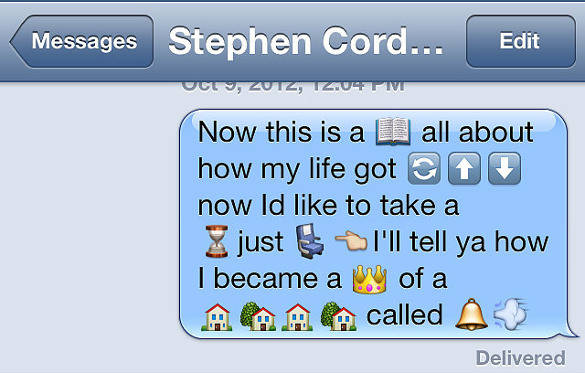
While not as time intensive or visually impressive, emojis do help to convey meaning when supplementing text and can easily be used to summarize even a whole book.

Image result for emoji story

The other “new comic” would be the meme. In any form that contains more than one picture, I believe it is quite clear how this new “art form” falls under the definition of comic. While many memes are low quality, take little effort, have no story and are overall just a delivery mechanism for some shitty joke, it is hard to find a person that hasn’t found one that they find funny.

Image result for expanding brain meme

While comic books and strips may be a bit less popular than they were a decade ago, the format lives on in the modern age and has been adopted by nearly everyone. From 13 year olds who use only emojis to talk to their friends,  to soccer moms who unironically use emojis completely wrong and those self-proclaimed “Meme Lords” who spend hours of their life making memes for fake internet points, often with surprising self-awareness. Comics are still here, and more prevalent than ever, most just don’t know it.

Economics of Attention

After opening up this week’s readings my first thought was: “Holy shit Doug, 50+ pages?” Then I had to remind myself that I was indeed in a college writing course and I hunkered down for some rousing reading on, well I wasn’t sure until I started because the titles initially seemed fairly cryptic.

Image result for thanks doug gif

The commentary that kicks off the “Stuff and Fluff” piece was something I definitely wasn’t expecting. I felt that it was quite philosophical but I figured I could play ball. Although this was written nearly 15 years ago, I feel the commentary towards the beginning on information has become more prevalent than ever. We live in an age where nearly any question we have can be answered. If we don’t know a piece of information, we can easily look it up on the internet.

Image result for monkey internet search gif

If nothing comes up we can ask those close to us without them even being near us. If that fails and we are dead set on finding our answer, we have the ability to cast an even broader net to get an answer. We can post about it on social media and have access to all those that know us, whether they be family, friends, or acquaintances. And if that fails (if you are, let’s say, a lonely orphan with no family or friends, or a weirdo like me that is only friends on social media with those closest to me), then we can go even one step further and dive deep into the depths of the internet.

Image result for darkweb gif

One of the best places to find an answer would be somewhere like Reddit where there are online communities geared toward just about anything imaginable, and even a subreddit for things that you have absolutely no clue about called r/whatisthisthing (Which I highly recommend you look at if you have a few minutes to spare.)

The piece goes on to discuss how, since there is such a surplus of information for us to consume, where is the balance in this information economy. I think Lanham is absolutely correct when they assert that what is on short supply in this economy due to this surplus is our attention. I don’t think I could agree anymore, especially given all the developments that have occurred since 2005. With the addition of smartphones, YouTube, and essentially any form of media being highly accessible at any time, nearly anywhere, our attention as consumers is more split than ever. We can listen to music, radio, books, or podcasts while walking or driving and can do that plus watch videos, do work, watch tv or movies just about anytime else if our vision isn’t needed.

Image result for whoa kid gif

So, where does this put us, as valuable consumers in this oversaturated media and information market? I would say that this position of power as a consumer burdens us with the responsibility of being conscious of what we consume. Its no longer as easy as switching on the radio and picking one of five channels. We now, I would argue, have to be intentional about what we consume instead of choosing what is most convenient. Lanham points out that the “capital” of this market is “imagination” and to that, I would add “quality.” So, as consumers, we should make our “capital investments” of our highly sought attention in things that we find the most valuable. For me, it is a select set of well-produced and informative podcasts, and an ever-expanding audiobook catalog of books that I want to read, and a few quality tv shows and youtube channels that keep me entertained and informed about my interests. Because in this digital economy, we should value our time as much as advertisers do and support what we like by giving it the time and attention it deserves.

A/V Process Reflection

To start my reflection, I think I will start with how my idea came to be and how the concept evolved, and then go more into the limitations that I met and how that ultimately shape my final product. Going into this project, and even before we started I had an idea of what I wanted to cover. Since coming back this semester I was extremely annoyed by the addition of “Reserved” spots in the SB lot in the fitness center. I found it annoying that these very limited spots that are extremely popular were decreased to make way for reserved spaces. I understand the concepts of capitalism, but what made me the most annoyed was that after two weeks it was blatantly obvious that these extra R spots were unnecessary.

The original spots are mostly unused throughout the whole day and I truly feel that the only reason the change was made was a money grab by Parking Services and the University as a whole, either to try and sell more R spots, or more diabolically, increase parking ticket revenue. The latter explanation is less pleasing but really makes the most sense, as these new spots are at the end on two SB parking rows that have historically been SB parking. This ploy works by limiting SB parking in a central lot on campus. People in a rush may just risk the ticket if they are late, and it may also confuse people that don’t realize the rows that start as SB spots, and are clearly labelled as such at the start of the row, suddenly change into parking for a permit that is over 4 times as expensive. Clearly, I am passionate about this ridiculous situation and could talk all day about it but I will move on to my video.

Initially, after seeing that many of the previous videos were about parking, I felt I should rethink my idea but since it was so specific to a recent change, I decided to move forward with the idea anyway. Being a regular user of YouTube I know what well-edited videos look like and foolhardily thought that I could easily mimic those styles with no background in video editing. I had a concept in my mind that I thought would be easily translated to the video and I was quickly corrected. Learning the capabilities of the software and not being able to dedicate all my time to one assignment, I decided on the genre of “YouTube conspiracy video.” These videos are infamous for mediocre editing, wild ideas, and heavy use of stock images. Using this idea, which matched perfectly with my skill set I proceeded to make my video in that style. Overall, I think the ideas and script for my video were pretty good for the three-minute time constraint, and the video and stock image editing is so bad that I think it makes the video a bit funnier, but I also have a terrible sense of humor.

Ultimately, the one aspect that I am disappointed by in my video is the commentary. I think the sound quality is pretty bad and it was difficult making the different takes sound alike but overall, I would say it is passable. The majority of learning in this project was with the editing software and I have a deep appreciation for people who edit and produce these internet videos. Even using the Rush version of Adobe Pro, there was a decent learning curve that I had to overcome. I feel that even after this one project my skills and understanding of videography has improved, if only minimally. This project gave me insight into the power that these softwares have and also into the amount of skill and practice needed to make content in this medium, which gives me a greater appreciation for all the people that do it for a living.

Wysocki, Bernhardt, and Wysocki. Thoughts on Modern Media and Digital Design.

The first thing that stuck out to me in Bernhardt’s piece was that he placed essays at the visually non-informative end of the spectrum. This concept was counter-intuitive to me. After all, words are visual, and therefore must in some way be visually informative, but the concept sank in the more I thought about it. Barring the actual text of a piece, very few things other than the words in an essay that convey information. He makes the point that there are indentations and punctuation in essays, but these visual cues are strictly defined for their individual use. In an essay, they exist primarily to make the structure visually pleasing and easy to read. There is no true meaning conveyed by the indentation of a new paragraph beside providing the reader with a clear indication that a new paragraph has been formed. This, I think, aligns with what Wysocki is saying in her introduction to her book. She gives commentary on how writing is changing, as really has always been changing. Writing and communication as a whole are much more than the words that make up any particular text. This I believe can be seen much better now than when Wysocki originally wrote her book. If we take a look at the form that modern media has taken over the past few years, it is truly amazing how sleek and immersive some articles and media can be, such as:

https://www.abc.net.au/news/2017-10-16/north-korea-missile-range-map/8880894

Or

https://www.abc.net.au/news/2017-09-13/same-sex-marriage-support-map-vote-compass/8788978

This highlights an important concept to take note of, especially in this digital age where our attention is constantly be fought for by countless different sites and modes of consuming media. The way information is delivered is just as important as the information being delivered. This is probably common sense for anybody familiar with marketing or advertising because it is the basic concept that those industries are built on. Making something that can grab and maintain people’s attention is what every person should be trying to do in the digital age.

“There is little or nothing that asks composers and readers to see then question the values implicit in visual design choices, for such design is often presented as having no value other than functionally helping readers get directly to the point” If there was one quote that has become dated in Wysocki’s “New Media,” I feel this may be the best example. Personally, I find design to be one of the defining characteristics of new media. If an app, website or article isn’t well put together and run smoothly, I feel no obligation to use it and will try to find a better alternative. This can be for better or worse. The challenging demands that I and many other media consumers have challenge people to become more creative, and create more visually pleasing and fun articles. A perfect example is The Guardian’s piece on the internet in communist countries:

https://www.theguardian.com/technology/ng-interactive/2019/jan/11/the-internet-but-not-as-we-know-it-life-online-in-china-russia-cuba-and-india

This article has so many small details in the design that make it exciting to read in addition to the interesting topic. It is the perfect example of setting a new standard for modern news articles. The downside to this is that the average person with limited resources may be pushed aside for not having such a gripping design. This doesn’t make new design for media a total scrub; it just means that when consuming it, we as an audience have to be aware of what purpose it is achieving. If the design of a news article is the only substance that it provides, then I feel we are in a much worse place than if we had settled for the classic information packed and visually bland essay.

Fisher and Porter

Today’s blog will be something a bit different from last’s, it will be more of a stream of concious thought on interesting parts of the reading. Welcome to this journey, hopefully you have the same expectations about this as you do about any Lifetime movie in existence, fairly low with the possibility of being pleasantly suprised.

Image result for shrug gif


“Humans as rhetorical beings are as much valuing as they are reasoning animals.” I find this quote significant and intriguing, partly because the author did the work for me in making it clear it was a good one by italicizing it. What I get from the rest of this paragraph is that logic and reason may not always be expressed in logical or reasonably ways. In fact, I would argue that unreasonable acts and statements, made to prove a point, stick with people better than the average reasonably boring way of putting it. The absurdist setting of Alice in Wonderland may be what makes it’s themes of growing up and finding identity more memorable than that of Heart of Darkness.

Image result for alice in wonderland growth gif

(I’ll be honest, growing up definitely isn’t a theme in a book about some grown-ass dude floating down the Congo in the middle of Africa, but overall I have lackluster feelings about this book and Joseph Conrad as a person so we can all just pretend that this was a good analogy)

Image result for smiling looking around gif

The piece goes on further to argue that all rhetorical situations are completely unique and circumstantial, as nearly all things outside of math and some science are. The exigence for every writing is different from author to author and each piece’s relevance and significance isn’t constrained to the author’s intent, but also to when in was written, who and why it was written for, and ultimately how each individual reader interprets the reading. Once something is published, the piece becomes just as much the reader’s as the author’s, maybe even more so. The author isn’t there for each reader to ask questions on the intent or purpose of what was written, the words are just sitting there for each individuals interpretation. Much how I am almost certainly extrapolating different ideas than the author intended from his/her writings.

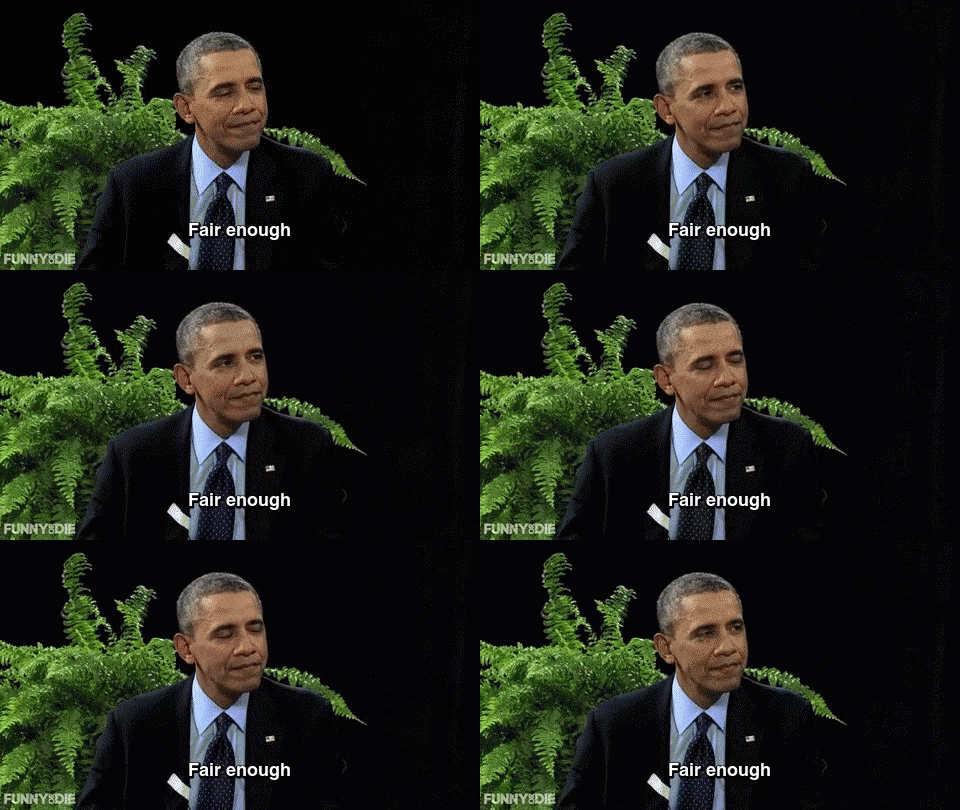
Image result for good enough gif

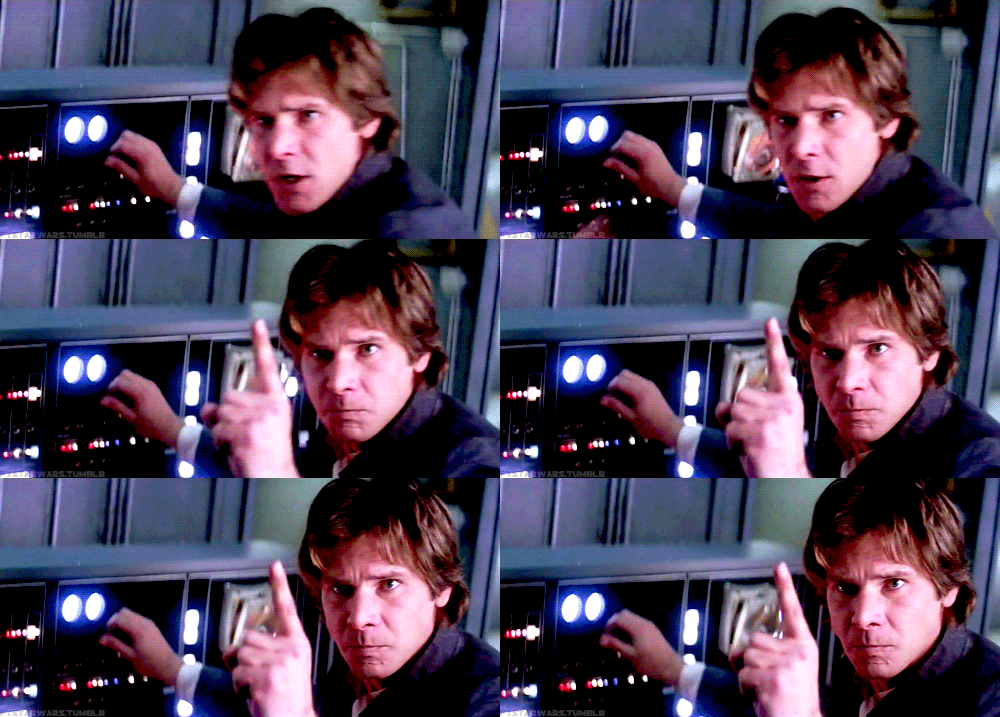
I suppose that this is what Porter’s piece on intertextuality is talking about. No writing is an island. Each writing, whether intentionally or not, relates to others. On the large scale they may represent a genre, a period in time, a school of thought, or a specific style of writing. They could connect with other texts more directly by referencing them, quoting them, or use similar themes and settings. These are what Porter describes as the two forms of intertextuality: Iterability and Presupposition. From what I understand, Iterability is the equivalent of using a star wars gif to make a point:

Image result for star wars pointing up gif

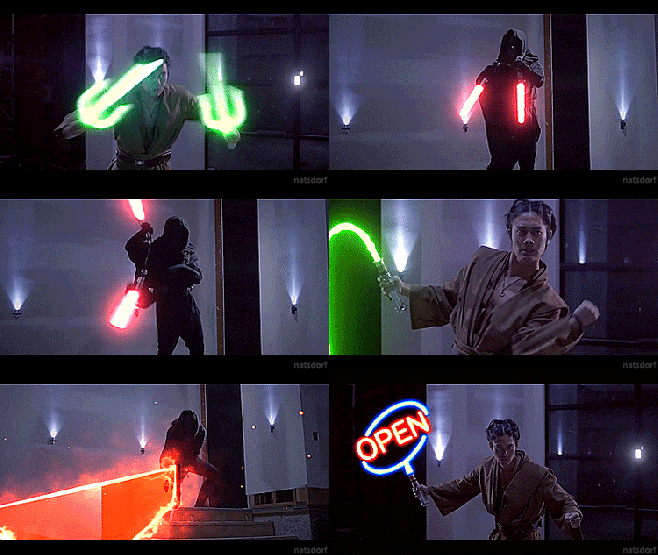
And Presupposition is me hoping you will appreciate this gif that is funny, but isn’t quite Star Wars, but you’ll find it funny because you have seen Star Wars and the concept is familiar but the content is new to you, or that as my audience you will at least have a similar sense of humor

Image result for star wars drawing meme gif

Overall, if I can be so cocky as to assume that I have grasped the overarching theme of this week, it seems that both of these texts were in one way or another saying that, everything references some other thing, even if it is unintentional, and the audience of a piece is just as important as the author and sometimes can find their own meaning for a piece based off of events that may not even be covered in the piece, even if it was unintended by the author.

And, with that eloquently written run-on sentence that would make my previous English professors sob in disgust, as they contemplate how they so horribly failed me as a writer, I am done.

Image result for dusting off hands gif